Telegram Mini Apps peaked at roughly 1.44 billion monthly active users in September 2024. By mid-2025 the figure had settled somewhere between 150 and 190 million. Nothing was banned and nothing broke technically. The rewards simply stopped arriving, and with them went the people who had come for the rewards.
Those numbers come from FindMiniApp data quoted in PropellerAds' December 2025 report on Telegram Mini App advertising, and they need reading for what they are: monthly active users summed across mini apps, not distinct human beings. The peak is larger than Telegram's entire user base, so a person who opened five apps was counted five times. Even discounted that way, this is the largest natural experiment in gamification ever run: roughly 1.25 billion monthly app users appeared and disappeared inside one messenger in under a year, driven, the report says, by tap-to-earn apps that inflated the ecosystem and then deflated it.
Telegram itself passed one billion monthly active users in March 2025 and did not shrink. The audience did not leave the platform. It left the games. Every channel owner who bolts a contest onto a content feed is running a small version of the same experiment, usually without noticing: a mechanic gets added, a spike happens, and a month later the channel is quieter than before. What follows is what the research says about why, and how to design an activity that does not eat the channel it was supposed to feed.
1. Gamification works. The question is what it works on#
There is one study every person about to "add a game element" should read first. Paschmann, Bruno, van Heerde, Völckner and Klein published it in the Journal of Marketing Research in 2025, using daily individual-level usage data from 18,952 users of a gamified market research app. The app paid people two ways: game rewards inside the game layer, and value rewards for completing surveys, which was the thing the business actually needed.
The findings, as summarised by UNSW BusinessThink from the paper: moving a user from low to high game-reward proximity "increased gameplay probability by 40% and time spent on gameplay by 124%", while proximity to value rewards "increased gameplay probability by 54% and survey completion rates by 62%". And then the sentence worth rereading: "When users achieved game rewards, their likelihood of completing surveys decreased by 63%, and the average time spent per survey dropped by 67%."
Gamification reliably, reproducibly and strongly raised game activity. And it just as reliably pulled attention away from the behaviour the whole system existed to produce. The authors also report that under high flow, the effect of game engagement on survey completion swung "from a 33% lift to a 20% reduction". The deeper into the game people fell, the less the game did for the business.
To keep this in proportion: overall, the authors find that game rewards "increase engagement significantly over and above value rewards, leading to a lift in business value". The 63% drop is local to the moment a game reward is reached, not the verdict on the whole mechanic.
Translate that into a channel. You launch a contest. Button clicks go up, comments go up, the announcement post gets excellent reach. And in exactly those days, the posts the channel exists for get read worse. People came to play, not to read. On paper, engagement improved. In practice, the channel spent a week as an arcade where your content was an obstacle between attempts.
This is not an argument against gamification. It is an argument for tying the mechanic to the target behaviour rather than parking it alongside. A mechanic where playing requires reading today's post, and a mechanic where playing requires pressing a button, produce the same activity spike and opposite outcomes for the channel.

2. The most expensive lesson in gamification cost over a hundred million users#
If you want one example that explains everything, it is Hamster Kombat.
The Telegram mini app went from launch to global phenomenon in weeks. By The Block's account, "Hamster Kombat's user base plummeted from 300 million in August to 41 million by November post-airdrop". The project's own team pushed back on the framing, clarifying that the 300 million figure "represent the total number of players, not the MAU" and that peak monthly active users were "north of 155 million". Take the conservative reading and the collapse is still from 155 million to 41 million in three months.
The Telegram channel tracked the same curve. Data from TGStat, reported by Nairametrics in October 2024, put the channel at 60.7 million subscribers at peak and 55 million by late October, shedding "an average of 200,000 subscribers on a daily basis". Google search interest for the name fell from 100 points in September to 3 in October. The trigger was the airdrop: the reward everyone had been working toward arrived, disappointed people, and the reason to open the app disappeared with it.
Psychologists have studied this since the early 1970s, long before Telegram existed. Deci, Koestner and Ryan's meta-analysis of 128 studies, published in Psychological Bulletin in 1999, found that "engagement-contingent, completion-contingent, and performance-contingent rewards significantly undermined free-choice intrinsic motivation (d = -0.40, -0.36, and -0.28, respectively)". Two conditions travel with those numbers and are usually dropped. They describe free-choice behaviour, meaning how much people keep doing the task once the reward is gone and nobody is watching; the effect on self-reported interest is weaker (d = -0.15 and -0.17). And the meta-analysis deliberately admitted only tasks that were at least reasonably interesting to start with, because a supplementary analysis of 13 studies found rewards undermining motivation for interesting tasks while maintaining or enhancing it for boring ones. Where the interest was already there, the reward eats it: remove the external reward and behaviour does not return to baseline, it lands below it.
The same paper found the mirror image, and it is the useful half: "Positive feedback enhanced both free-choice behavior (d = 0.33) and self-reported interest (d = 0.31)." Recognition builds. Payment, once withdrawn, subtracts.
For a channel this plays out as follows. People read you because it was interesting. You introduced points for reactions. Now they react for points. You cancelled the points. There are now fewer reactions than before the experiment started, because you rewrote the motive with your own hands: it was "I find this interesting", it became "I get paid for this", and now nobody is paying.
The working rule: a reward must not be the reason for an action. It must be confirmation that the action was noticed. The distinction sounds thin and decides everything.

3. Points and badges are the boring part of a game#
In 2010 game designer Margaret Robertson proposed the term pointsification. Frontiers in Education revisited the argument in a 2023 paper and quotes her directly: points are "the least important bit of a game, the bit that has the least to do with all of the rich cognitive, emotional and social drivers which gamifiers are intending to connect with".
The idea is simple. Points, levels and badges are not the game. They are its accounting. Games are interesting because of choice, risk, growing mastery and other people, not because a counter goes up. Copy only the counter and you have copied the dullest component. The Frontiers authors make the same split explicit: pointsification is "a smaller approach, focusing on a few elements (points, badges, and leaderboards) that are easier to implement".
A sobering number for anyone expecting miracles. Li, Hew and Du's meta-analysis in Educational Technology Research and Development covered 35 independent interventions involving 2,500 participants and, for students' intrinsic motivation, found "an overall significant but small effect size favoring gamified learning over learning without gamification (Hedges' g = 0.257, 95% CI [0.043, 0.471], p = .019)". Significant, real, and small. Against vendor promises of "+150% engagement", that is a useful piece of ballast.
So what does work? The same meta-analysis points at the answer. Gamification moved perceptions of autonomy strongly (Hedges' g = 0.638) and relatedness very strongly (Hedges' g = 1.776), but barely moved perceived competence (Hedges' g = 0.277, p = .049, with the confidence interval starting at 0.001). The authors' own diagnosis of why intrinsic motivation moved so little names two culprits: "students' lack of perceived competence and lack of perceived autonomy in gamified classes".
That maps onto Self-Determination Theory, which holds that autonomy, competence and relatedness are the conditions that "foster the most volitional and high quality forms of motivation and engagement". A mechanic retains people to the extent it satisfies those three needs, and retains nobody if it only satisfies a wallet.
For a channel:
- autonomy means several parallel ways to take part rather than one compulsory activity. Some people answer questions, some play, some bring friends;
- competence means visible personal progress and difficulty a person can actually meet. They should be able to tell they got better, not that they got lucky;
- relatedness means team mechanics and naming participants in the channel's own posts.
Two more frames are worth keeping on the desk. Yu-kai Chou's Octalysis splits eight core drives into White Hat (meaning, accomplishment, creativity) and Black Hat (scarcity, unpredictability, loss avoidance). Black Hat is an excellent accelerator: "two hours until the contest closes" genuinely lifts participation. A community built only on Black Hat repeats the Hamster Kombat trajectory. And Richard Bartle's 1996 taxonomy divides players into Achievers, who "give themselves game-related goals, and vigorously set out to achieve them", Explorers, Socialisers and Killers, which carries an unwelcome consequence for ranking enthusiasts: a leaderboard speaks to only two of the four types, the achievers and the competitors. It has little to offer explorers or the people who came to socialise.

4. The leaderboard is the most overrated mechanic in communities#
A public ranking of everyone looks like the obvious solution and usually is not.
The strongest evidence is a longitudinal quasi-experiment by Do, Jin, Priest, Meredith and Landers, published in Learning and Individual Differences in 2024. They randomly assigned groups to leaderboard conditions in a college course and tracked optional practice over time. The result, in their words: "Although practice behaviors were linked to course performance, the leaderboard did not meaningfully affect those practice behaviors and also negatively affected course performance through other mediators." Their own summary is blunter still: "leaderboards did not encourage additional practice and, unexpectedly, led to lower exam scores."
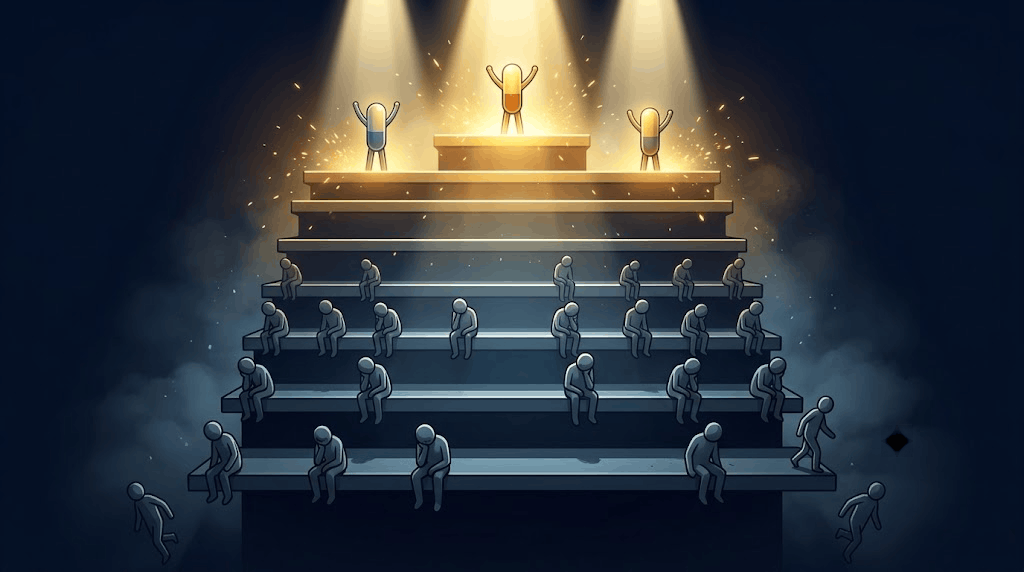
The mechanic breaks arithmetically. In a table of 500 people, the top ten get motivation and 490 get confirmation that they do not count. The fairer the ranking, the more stable the top, and the faster everyone else stops trying.
Now the honest counterargument, because the data are not one-sided. Duolingo built one of the most successful engagement systems in consumer software on exactly this element. Jorge Mazal, the company's chief product officer through that period, wrote publicly that when leaderboards launched, "overall learning time increased by 17%, and the number of highly engaged learners (users who spend at least 1 hour a day for 5 days a week) tripled". Over four years the wider programme produced "an increase in our DAU of 4.5x" and a 21% rise in retention, described as "a reduction in the daily churn of our best users by over 40%".
The difference is not that Duolingo has a leaderboard and the college course had one. It is what kind. Duolingo's ranking is a league of roughly thirty comparable people with promotion and relegation and a weekly reset, not one global table. Nobody is ever ranked 40,000th. Almost everyone is somewhere near a boundary that is still reachable this week.
That gives you the design rules:
- leagues and divisions, so a person is compared with twenty similar people rather than with the champion;
- personal progress, "better than your last result" instead of "you are 314th";
- seasonal resets, so everyone gets a fresh shot and the top does not set like concrete;
- multiple categories: fastest, most persistent, most accurate, newcomer of the week.
5. Praise the newcomers, not the champions#
This is the most underused practical finding in the whole area, and it is well evidenced.
A causal-inference study of 11 million Reddit posts across four months examined what public positive feedback does to the person receiving it. Users who received it "made more frequent (2% per day) and higher quality (57% higher score; 2% fewer removals per day) posts compared to a set of matched control users". Score here is net upvotes, and the authors themselves note that votes are not a reliable proxy for quality.
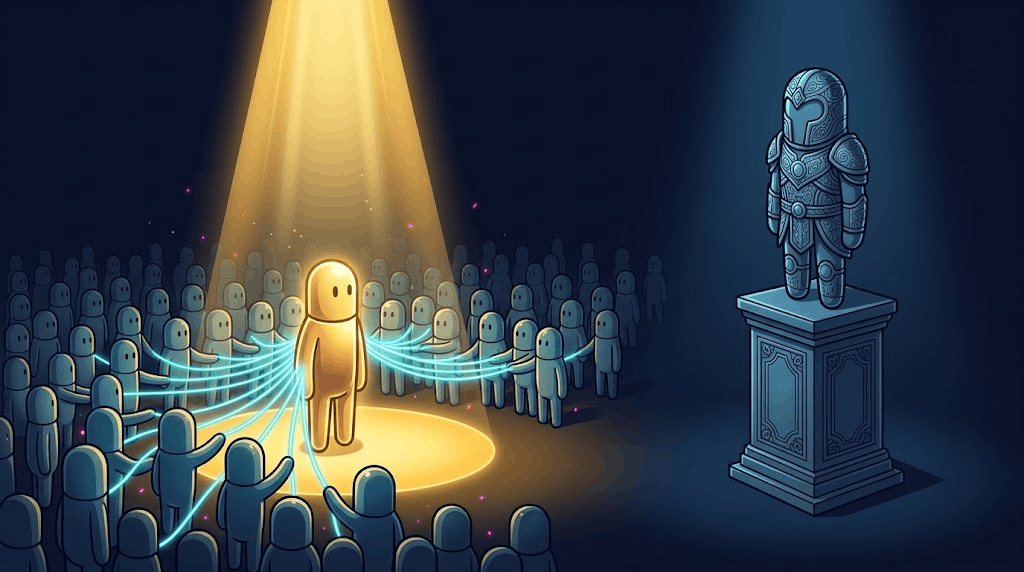
The interesting part is the breakdown. The authors report that "newer accounts/authors experience the largest effects of being highly upvoted on their daily posting frequency and daily removal rates", and explain why: "Reddit newcomers may be especially motivated by score to both continue contributing to a community and also learn more about the community's norms." Recognition does two jobs at once for a new person, encouraging them and teaching them what counts as good here.
The same study found a deprivation effect: "users who had not recently been highly-upvoted experienced larger increases in their future score when experiencing the score treatment", while people already swimming in recognition responded much less. Attention is worth most where it is scarce. For a veteran, recognition confirms status. For a newcomer, it is permission to stay. The first is pleasant, the second changes behaviour.
Hence a recurring slot worth adding to any channel that runs activities: regularly and publicly mark the people taking part for the first time, not the people at the top of the ranking. It costs nothing, and recognition, unlike payment, adds to motivation instead of washing it out (the mirror image in the Deci meta-analysis from section three).
6. How to design an activity that does not eat the channel#
Everything above collapses into a working order of operations.
Step 1. Name the target behaviour. Not "engagement" but a specific act: reading posts to the end, substantive comments, clicks through to the site, enquiries, coming back the next day. If the target behaviour is not named, the game will quietly become the target behaviour. See the 63% drop in section one.
Step 2. Make the game a route to that behaviour, not an alternative to it. The keyword for the draw is hidden in today's post. The quiz question comes from this week's material. An extra attempt is granted for bringing a friend. The mechanic should run through the content, not stand beside it.
Step 3. Check the mechanic against the three needs. Is there a choice (autonomy)? Can a person see themselves improving (competence)? Are other people visible (relatedness)? If all three answers are no, you have pointsification, and it will not hold.
Step 4. Ration the Black Hat. Deadlines, limited prize pools, unpredictable outcomes are accelerators. They belong in the finale of an activity, not in its foundation.
Step 5. Decide in advance what happens afterwards. The main failure of gamification does not occur during the contest but on the day after it. If nothing remains once the prize is handed out, no status, no accumulated progress, no next season, you get your own small Hamster Kombat. What holds people is the investment they would hate to abandon: a rank, a collection, a streak. Not the prize.
Step 6. Assume the prize will attract prize hunters. Any reward instantly draws people who came for the reward rather than for you, which is the whole story of the tap-to-earn cohort that inflated Telegram Mini App usage to 1.44 billion monthly app users and then vanished. Verify conditions twice, on entry and again before results are declared, because a meaningful share of entrants unsubscribe the moment they are registered. And watch the gap between subscriber count and the reach of ordinary posts: a large and growing gap means you bought accounts, not readers.
Step 7. If there is a brand behind the channel, let it into the game itself. A meta-analysis of advergame experiments (38 datasets) found that people like a branded game more than ordinary advertising and choose the brand more often afterwards. The effect is modest but consistent. What works is not a logo in the background but a brand the player does something with: catches it, collects it, wins it. The same research comes with two caveats. A game works on liking, not on memory: attention goes to play, and a brand inside a game is remembered even worse than in ordinary advertising. And the same branded game wears out fast: with repeated play, brand attitudes in the experiments went down. So rotate the mechanics. No such studies exist for Telegram channels yet; these are experiments with standalone branded games.
7. What counts as an honest result#
Metrics worth judging an activity by:
| What to measure | Why |
|---|---|
| Subscribers gained over the period and how many are still there after 30 days | The second number matters more than the first. Growth without retention is renting an audience |
| Reach of ordinary posts before, during and two weeks after | The cannibalisation check from section one |
| Share of participants who return for a second activity | The clearest signal that the mechanic runs on White Hat drives |
| Number of people who did something in the channel for the first time | The newcomer effect, measured |
| The funnel: saw it, opened it, started, finished, met the conditions | Shows where people are lost, not just the total |
And one metric not worth counting: reactions under the announcement post. It always goes up and it means nothing.

What it comes down to#
Gamification is not a button marked "make the channel alive". It is a tool with a documented side effect: it amplifies the behaviour it points at and weakens the behaviour next to it. Which means the outcome is decided at the design stage, not the launch.
Three things worth taking away:
- Tie the game to the target behaviour, or the game becomes the target behaviour.
- A reward is confirmation, not a cause. The cause has to stay internal.
- Think about the day after the contest before you think about the contest.
This piece was written by the Re:Activity team. We build contests people actually play rather than press one button for: eleven game mechanics at launch, three of them with no direct analogue, full visual branding of the game itself, double-checked entry conditions and publicly verifiable results, across Telegram, VK and MAX from one dashboard. If you want to talk through a mechanic for your own channel, write to us and we will work through it at no charge.
Sources
- Paschmann J.W., Bruno H.A., van Heerde H.J., Völckner F., Klein K. Driving Mobile App User Engagement Through Gamification. Journal of Marketing Research, vol. 62(2), 2025, pp. 249-273. https://journals.sagepub.com/doi/10.1177/00222437241275927 ↑
- How gamification drives mobile app engagement and business value. UNSW BusinessThink, 2025 (detailed effect sizes from the study above). https://www.businessthink.unsw.edu.au/articles/mobile-app-gamification-strategies ↑
- Research Insight: Driving Mobile App Engagement Through Gamification. American Marketing Association. https://www.ama.org/research-insights/driving-mobile-app-engagement-through-gamification/ ↑
- Deci E.L., Koestner R., Ryan R.M. A Meta-Analytic Review of Experiments Examining the Effects of Extrinsic Rewards on Intrinsic Motivation. Psychological Bulletin, 125(6), 1999, pp. 627-668. https://depts.washington.edu/techdocs/papers/deciExtrinsicRewardsAndIntrinsicMotivation99.pdf ↑
- Li L., Hew K.F., Du J. Gamification enhances student intrinsic motivation, perceptions of autonomy and relatedness, but minimal impact on competency: a meta-analysis and systematic review. Educational Technology Research and Development, 2024. https://link.springer.com/content/pdf/10.1007/s11423-023-10337-7.pdf ↑
- Do N., Jin T., Priest R., Meredith L.N., Landers R.N. A longitudinal quasi-experiment of leaderboard effectiveness on learner behaviors and course performance. Learning and Individual Differences, vol. 116, 2024, art. 102572. https://experts.umn.edu/en/publications/a-longitudinal-quasi-experiment-of-leaderboard-effectiveness-on-l/ ↑
- Does Positive Reinforcement Work? A Quasi-Experimental Study of the Effects of Positive Feedback on Reddit. arXiv, 2024. https://arxiv.org/abs/2409.20410 ↑
- Pointsification, gamification and the distinction between them. Frontiers in Education, 2023. https://www.frontiersin.org/journals/education/articles/10.3389/feduc.2023.1212994/full ↑
- Ryan R.M., Deci E.L. Self-Determination Theory: overview of the basic psychological needs. https://selfdeterminationtheory.org/theory/ ↑
- Chou Y. The Octalysis Framework for Gamification and Behavioral Design. https://yukaichou.com/gamification-examples/octalysis-complete-gamification-framework/ ↑
- Bartle R.A. Hearts, Clubs, Diamonds, Spades: Players Who Suit MUDs, 1996. https://mud.co.uk/richard/hcds.htm ↑
- The State of Telegram Mini App Advertising in 2025. PropellerAds, 18 December 2025, with Mini App audience data from FindMiniApp (MAU aggregated across mini apps). https://propellerads.com/blog/adv-telegram-mini-app-advertising-report/ ↑
- Telegram games had trouble earning revenue and retaining users in Q4. The Block, 2024. https://www.theblock.co/post/339563/telegram-games-had-trouble-earning-revenue-retaining-users-in-q4-report ↑
- Hamster Kombat Telegram subscribers drop to 55 million in October. Nairametrics, 2024, citing TGStat data. https://nairametrics.com/2024/10/24/hamster-kombat-telegram-subscribers-drop-to-55-million-in-october/ ↑
- Mazal J. (former Chief Product Officer, Duolingo). How Duolingo reignited user growth. Lenny's Newsletter, 2023. https://www.lennysnewsletter.com/p/how-duolingo-reignited-user-growth ↑
- Telegram surpasses 1 billion monthly active users. The Block, 2025. https://www.theblock.co/post/348630/telegram-surpasses-1-billion-monthly-active-users-fueling-bombies-rise-as-the-top-earning-game-on-the-ton-ecosystem ↑
- van Berlo Z.M.C., van Reijmersdal E.A., Eisend M. The Gamification of Branded Content: A Meta-Analysis of Advergame Effects. Journal of Advertising, 2021, 50(2), 179-196. https://doi.org/10.1080/00913367.2020.1858462 ↑
- Cauberghe V., De Pelsmacker P. Advergames: The impact of brand prominence and game repetition on brand responses. Journal of Advertising, 2010, 39(1), 5-18. https://doi.org/10.2753/JOA0091-3367390101 ↑
Comments (0)
No comments yet. Be the first!
Sign in to leave a comment
Sign in